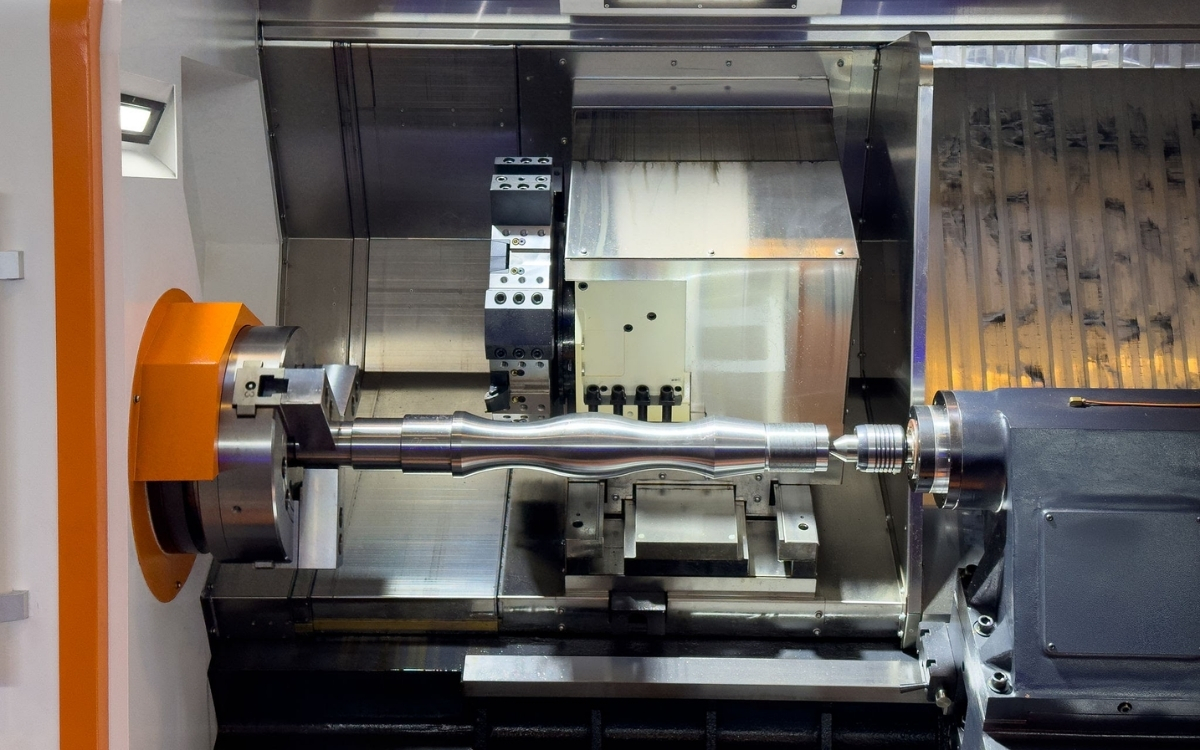

CNC Lathe vs Conventional Lathe: Which One Is Right for Your Workshop?
Selecting the right turning equipment is a critical capital decision for any machine shop or industrial facility. Both CNC lathes and conventional (manual) lathes shape rotating workpieces against stationary cutting tools, but they cater to fundamentally different operational models, batch sizes, and production workflows.
Quick Comparison: CNC vs Conventional Lathes
Conventional (Manual) Lathe
Primary Focus: Low volume, one-off prototypes, and emergency repair jobs.
Operation: Direct human control via handwheels, mechanical levers, and feed dials.
Precision & Repeatability : Operator-dependent; relies on machinist craftsmanship and machine condition.
Part Geometry: Ideal for straightforward cylindrical turning, facing, and standard threads.
Investment & Lead Time: Lower capital expenditure with minimal setup time to first cut.
Operator Skill Focus: Hands-on manual machining craftsmanship and measurement technique.
CNC Lathe (Turning Center)
Primary Focus: Medium to high-volume batch and serial production.
Operation: Automated execution via pre-programmed G-code and M-code commands.
Precision & Repeatability: High process stability and consistent, repeatable automated tool paths.
Part Geometry: Handles complex contours, arcs, threading operations, and multi-axis profiles.
Investment & Lead Time: Higher machine and tooling investment; requires CAD/CAM programming and dry runs.
Operator Skill Focus: CAD/CAM programming, tool offset setup, and automated process management.
How Each Lathe Works
Conventional Lathe
A conventional lathe relies entirely on the operator to control the relative motion between the cutting tool and the spinning workpiece. The machinist manually adjusts the cross-slide and carriage handwheels, sets spindle speeds via mechanical gearboxes, and engages mechanical lead screws for thread cutting.
Because the operator directly manages every pass, conventional lathes offer immediate tactile feedback. The operator can feel tool pressure, monitor chip formation, and make on-the-fly adjustments without writing code or setting up digital parameters.
CNC Lathe
A Computer Numerical Control (CNC) lathe automates tool movement using pre-programmed instructions generated from CAD/CAM software or direct conversational programming. Servomotors drive the X and Z axes (and additional C/Y axes on advanced turning centers) with precise position encoding.
Once the program is proven, workholding is established, and tool offsets are registered, the CNC lathe executes identical machining cycles repeatedly with minimal human intervention.
Key Technical Differences
Precision and Repeatability
Conventional lathes can achieve tight tolerances in skilled hands, but consistency across a large batch depends heavily on operator fatigue, thermal drift, and manual measuring equipment.
CNC lathes use programmed axis movements and feedback systems to provide consistent tool positioning and repeatability. Actual dimensional accuracy depends on machine construction, calibration, tooling, thermal conditions, workholding, and process control.
Setup and Lead Times
Conventional machines require no programming, making them ready to cut metal immediately. This makes them ideal for quick turnarounds on single components. Conversely, CNC lathes require program development, tool offset measurements, fixture alignment, and a dry-run verification pass before commencing automatic operation.
Advantages and Limitations
Conventional Lathes
Advantages:
Minimal Programming Requirement: No G-code generation or CAD modeling required before turning a part.
Cost-Effective for Single Parts: Low operational setup cost makes one-off jobs and emergency repair parts economical.
Direct Tactile Feedback: Experienced machinists can read cutting resistance directly through the controls.
Limitations:
Complex multi-radius or parabolic profiles are extremely difficult and labor-intensive to produce manually.
High reliance on individual machinist skill creates variable throughput and quality risk.
Slower cycle times on medium-to-large production runs.
CNC Lathes
Advantages:
High Repeatability and Consistency: Delivers consistent part quality across multi-shift production runs.
Complex Geometry Capabilities: Can machine complex tapers, arcs, multi-start threads, and intricate internal profiles with appropriate tooling and programming.
Automated Production Capabilities: Can be equipped with bar feeders, gantry loaders, and parts catchers for continuous batch processing.
Limitations:
Higher initial capital outlay for equipment, specialized tooling, and control software.
Program setup and verification make single, extremely simple parts cost-ineffective compared to manual turning.
Which Lathe Should You Choose?
Choose a Conventional Lathe if:
Your workshop specializes in industrial maintenance, equipment repair, re-facing, or custom one-off fabrications.
Your typical batch size is between 1 and 5 identical units.
You need an economical machine for secondary operations, polishing, or simple chamfering.
Choose a CNC Lathe if:
You hold supply contracts requiring serial production, repetitive orders, or OEM parts supply.
Your component designs include complex radii, profiles, threading operations, or contours that would be difficult to machine manually.
You need to reduce per-part labor costs and maximize daily workshop throughput.
What to Consider When Buying a CNC Lathe
When selecting a CNC lathe for your production facility, evaluating key machine specifications ensures the equipment matches your operational demands:
Maximum Turning Diameter & Swing Over Bed: Defines the maximum diameter of the workpiece the machine can safely rotate.
Maximum Turning Length: Defines the maximum axial length of the workpiece that the machine can accommodate for turning operations.
Spindle Speed & Motor Power (kW): Dictates cutting velocity and torque required for tough materials like stainless steel, alloy steels, or nickel alloys.
Chuck Size & Bar Capacity: Determines workholding options and the maximum raw bar stock diameter that can feed through the spindle drawtube.
Turret Type & Tool Stations: Number of indexable tool positions (e.g., 8, 12, or 16 stations) and whether static or live (driven) tooling is supported for secondary milling operations.
Axis Configuration: Standard 2-axis (X/Z), 3-axis (X/Z/C with live tools), or multi-axis turning centers with Y-axis and sub-spindles.
Tailstock Type: Programmable hydraulic or manual tailstock for supporting long shafts.
CNC Controller System: Industry-standard controllers (e.g., Fanuc, Siemens, Heidenhain, or Mitsubishi) affect programmer familiarity and shop floor integration.
Rapid Traverse Rates & Accuracy: Axis feed speeds and positioning resolution, supported by linear glass scales if ultra-fine accuracy is required.
Automation Options: Compatibility with automatic bar feeders, chip conveyors, coolant pressure systems, and parts unloaders.
After-Sales Support & Spare Parts Availability: Local technician availability, warranty coverage, and quick response times for critical maintenance.
Applications in Saudi Manufacturing
As manufacturing, infrastructure, and industrial capacity expand across Saudi Arabia under Vision 2030, choosing the right machinery is essential for local workshops and industrial plants in key regions like Riyadh, Jeddah, Dammam, and Jubail.
Oil & Gas Component Manufacturing: High-rigidity CNC turning centers handle heavy-wall piping, API thread profiles, valves, and flange connections in eastern province industrial hubs like Dammam and Jubail.
Industrial Maintenance & Repair (MRO): Conventional lathes remain indispensable in repair shops supporting cement plants, desalination facilities, and refineries where worn shafts and custom bushings must be remachined immediately.
Construction & Earthmoving Equipment: Heavy-duty turning lathes support repair and manufacture of hydraulic cylinder rods, pins, and bushings for construction fleets across Riyadh and Jeddah.
General Metal Fabrication & OEM Parts: Mid-sized CNC lathes drive scalable production for structural fittings, fasteners, and custom engineered components across Saudi Arabiau2019s expanding industrial cities.
Explore our range of CNC lathes and metalworking machinery for different production requirements.
Frequently Asked Questions
Q : What is the main difference between a CNC lathe and a conventional lathe?
Ans : The primary difference is the control mechanism. A conventional lathe is operated manually using handwheels and mechanical controls, whereas a CNC lathe uses computerized G-code programs to automatically drive axis movements and spindle speeds.
Q :Is a CNC lathe more accurate than a conventional lathe?
Ans : A CNC lathe generally offers superior operational consistency and repeatability across batches because tool paths are automated. While a highly skilled machinist can produce precise parts on a well-maintained conventional lathe, the CNC lathe eliminates operator-dependent dimensional variations during multi-part runs.
Q : Which lathe is better for small production runs or one-off parts?
Ans : For single repair jobs or low-quantity prototypes (1 to 3 pieces), a conventional lathe is often faster and more cost-effective because it eliminates the time required for G-code programming, CAD design, and CNC setup.
Q : Is a CNC lathe worth the investment for a small workshop?
Ans : A CNC lathe can be a worthwhile investment for a small workshop when the business has recurring production work, complex components, or plans to increase machining capacity. For occasional repair and one-off work, a conventional lathe may be more appropriate.
Q : Can a CNC lathe replace a conventional lathe completely?
Ans : While a CNC lathe can machine almost any part a conventional lathe can, many busy machine shops maintain both. Keeping a conventional lathe on the shop floor prevents tying up high-value CNC machines with quick facing, deburring, or emergency shaft repair tasks.
Q : What type of lathe is suitable for mass production?
Ans : CNC lathes, especially those equipped with automatic bar feeders, multi-station tool turrets, live tooling, and sub-spindles, are the standard choice for medium to high-volume manufacturing.
Q : What should I consider before buying a CNC lathe?
Ans : Key factors include maximum turning diameter and length, spindle power and speed range, chuck capacity, number of turret stations, controller brand, machine rigidity, and local after-sales service and spare parts support.